How to Reduce Labour Costs in Your Workshop by 20-40% with Time Tracking
- Mark Bennet

- 6 days ago
- 5 min read
If you run a workshop in New Zealand — joinery, engineering, composites, whatever — labour is almost certainly your biggest cost. For most manufacturers, it sits somewhere between 40% and 60% of total expenses.
And here's the part that stings: a good chunk of that spend is invisible. Time gets lost in ways that never show up on a timesheet. Untracked rework. Jobs that run over without anyone noticing until the invoice goes out. Staff switching between tasks without logging the change.
The result? You're quoting based on guesses, billing based on memory, and wondering why margins keep slipping. That's where workshop time tracking software comes in.
Workshop time tracking software fixes this. Not by making people work harder — by making the time they already work visible, measurable, and actionable.
Where Labour Costs Actually Leak

Most workshop owners know their hourly rate. What they don't know is where those hours actually go.
Here are the most common leaks we see across NZ manufacturing workshops:
Untracked rework. A job comes back because of a measurement error or a client change. The fix takes two hours. Nobody logs it against the original job. Your job costing data now says that job was profitable — but it wasn't.
Task switching without logging. A fabricator gets pulled off Job A to do something urgent on Job B. They don't update their time. Job A looks like it took longer than it did. Job B looks like it cost nothing. Both estimates are wrong.
Setup and teardown time. Changing tooling, setting up jigs, cleaning down between jobs. This time is real — it costs you money — but it rarely gets tracked. So your quotes never account for it.
Idle time between jobs. Waiting for materials. Waiting for instructions. Waiting for the CNC to finish. These gaps add up to hours per week, per person.
Admin and non-productive time. Meetings, stock takes, cleaning, maintenance. All necessary. All rarely tracked. All eating into your productive capacity.
What Changes When You Start Tracking
When workshops start using time tracking software properly, the first thing that happens isn't cost reduction. It's visibility.
You start seeing where time actually goes. And that changes everything.
Accurate job costing

Once every hour is logged against a job, you know — really know — what each job costs. Not what you estimated. Not what you hoped. What it actually cost in labour.
This does two things. First, it shows you which jobs are profitable and which ones are bleeding money. Second, it gives you the data to quote more accurately next time.
Workshops using Empower Software typically see their quoting accuracy improve within the first month. When you can see that a standard kitchen install actually takes 38 hours instead of the 30 you've been quoting, you can adjust your pricing to protect your margins.
Identifying bottlenecks
Time data shows you where work gets stuck. Maybe your spray booth is a bottleneck — every job waits two days for finishing. Maybe your CNC operator is running at 110% while two bench hands are at 60%.
You can't fix what you can't see. Time tracking makes the bottlenecks visible.
Reducing non-productive time
Most workshops find that 15-25% of paid time is non-productive. Not because people are lazy — because the systems around them create waste. Waiting for materials, searching for drawings, redoing work because of poor communication.
Once you can measure non-productive time, you can start systematically reducing it. Even a 5% improvement in productive time across a 10-person workshop is worth thousands per year.
Better scheduling
When you know how long jobs actually take (not how long you think they take), you can schedule more accurately. Less overtime. Fewer missed deadlines. Better workflow through the shop.
The 20-40% Claim: Where Does It Come From?
Let's break this down with a realistic example. Say you run a 10-person joinery workshop. Average loaded labour cost per person is $35/hour. That's $728,000 per year in labour (assuming 2,080 hours per person). Here's where the savings come from:
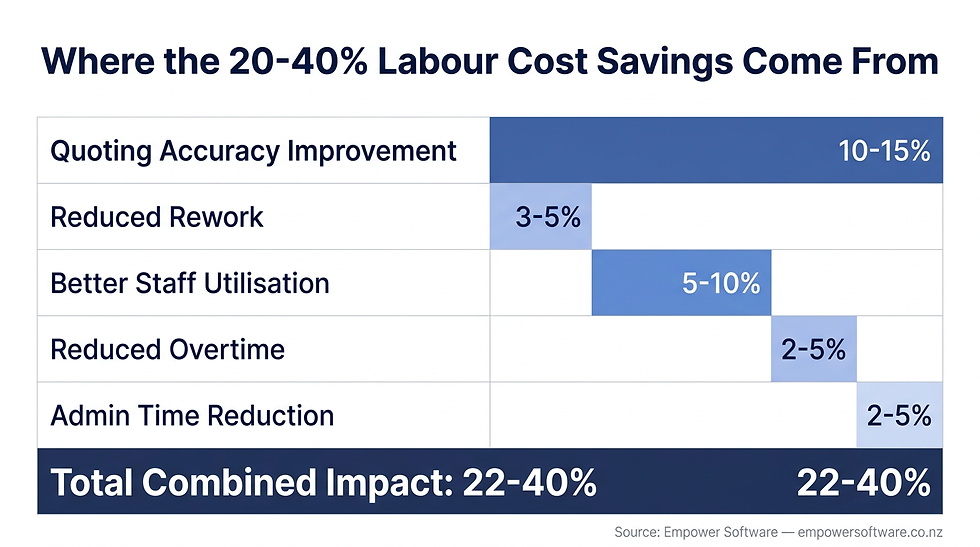
Quoting accuracy improvement (10-15% of labour cost saved). You stop underquoting jobs. Those 10% of jobs you were losing money on? Now you're pricing them correctly. That's not a cost reduction — it's revenue recovery. But it hits the bottom line the same way.
Reduced rework (3-5% saved). When every job is tracked and visible, errors get caught earlier. Rework drops because accountability increases and you spot patterns — which jobs, which processes, which team members generate the most rework.
Better utilisation (5-10% saved). Scheduling improves. Idle time drops. You get more productive hours out of the same team. That might mean you don't need to hire that extra person you were thinking about.
Reduced overtime (2-5% saved). Better scheduling and visibility means fewer last-minute rushes. Overtime drops.
Admin time reduction (2-5% saved). Time tracking software that integrates with your accounting system (like Xero, MYOB, or QuickBooks) means less manual data entry. Timesheets flow straight into payroll. Job cost reports generate automatically.
Add those up and you're looking at 22-40% in combined labour cost impact. Not every workshop hits the top end, but most see meaningful improvement within the first few months.
What to Look for in Workshop Time Tracking Software

Not all workshop time tracking software is built for manufacturing. A generic timesheet app won't cut it. Here's what matters for workshop environments:
Job-based tracking. You need to track time against specific jobs, not just "hours worked." Every minute should be linked to a job number so your costing is accurate.
Easy for the shop floor. If it takes more than 10 seconds to clock onto a job, your team won't use it. Look for touchscreen kiosks, barcode scanning, or simple tablet interfaces. The less friction, the better the data.
Real-time visibility. You want to see what everyone's working on right now. Not at the end of the week when timesheets come in. Real-time data lets you catch problems while you can still fix them.
Accounting integration. If your time data doesn't flow into Xero, MYOB, or QuickBooks automatically, you're just creating a new admin task. Integration is essential.
Scheduling. The best workshop software combines time tracking with job scheduling. Track where time goes, and plan where it should go — in one system.
NZ-specific. Tax rules, leave calculations, public holidays — these all matter. Software built for or well-adapted to the NZ market saves you headaches.
Getting Started Without the Pain
The biggest fear most workshop owners have about time tracking software is disruption. "My guys will hate it." "It'll slow everything down." "We'll spend months getting it set up."
Here's what actually happens with a good system: implementation takes one to two weeks, not months. The software should come with templates for your industry — joinery, engineering, composites — so you're not building everything from scratch.
Start with basic time tracking. Get your team used to clocking on and off jobs. That alone gives you data you've never had before. Then layer on scheduling, reporting, and deeper analysis over the following weeks.
The key is picking software that's built for workshops, not adapted from some generic project management tool. The closer the fit, the faster the results.
The Bottom Line
Labour is your biggest cost. Right now, you're probably managing it with a mix of paper timesheets, gut feel, and end-of-month surprises.
Workshop time tracking software gives you visibility. Visibility gives you control. Control gives you the ability to reduce costs by 20-40% — not through cutting staff, but through eliminating waste, improving accuracy, and making better decisions.
If you run a manufacturing workshop in New Zealand and you're not tracking time properly, you're leaving money on the table. The question isn't whether you can afford time tracking software. It's whether you can afford not to have it.
Empower Software helps over 250 NZ manufacturers track time, cost jobs accurately, and reduce labour costs. With a Productivity Gain Guarantee, you've got nothing to lose. See how it works →

Comments