The True Cost of Not Tracking Time in Your Engineering Workshop
- Mark Bennet

- Apr 30
- 6 min read

You know time tracking matters. You've probably thought about implementing it properly more than once. But between running the shop, managing clients, and keeping jobs moving, it keeps getting pushed to "next quarter."
Meanwhile, the cost of not tracking time keeps compounding. Not in one big, obvious hit — but in dozens of small leaks that add up to tens of thousands of dollars per year.
Here's an honest look at what those leaks actually cost a typical NZ engineering workshop. No vague promises. Just maths.
Leak 1: Inaccurate Quoting
This is the big one. And it works against you in both directions.
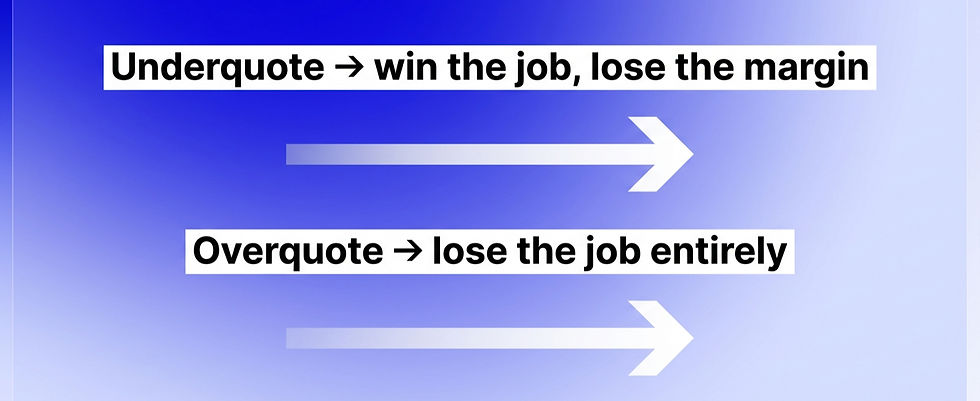
Underquoting means you win jobs and lose money on them. Your estimate says 20 hours. The job takes 28. You bill for 20 because that's what you quoted. Eight hours of labour — gone.
Overquoting means you lose jobs you should have won. Your estimate says 40 hours because you're padding for the unknown. The job would have taken 30. A competitor quotes 32 and gets the work.
Both problems come from the same root cause: you don't have accurate data on how long things actually take.
Without time tracking, your quotes are based on memory, experience, and gut feel. These aren't bad inputs — but they're unreliable ones. Memory overweights recent jobs. Experience drifts as your team changes. Gut feel is biased toward optimism.
What this costs: Take a 10-person engineering workshop doing $2 million in annual revenue. If quoting inaccuracy (in either direction) affects just 10% of your jobs by 15%, that's $30,000 per year in either lost margin or lost opportunity. Most shops are worse than that.
Leak 2: Hidden Rework
Rework happens. A dimension gets misread. A weld fails inspection. The client changes the spec mid-job. Parts need remaking.
The question isn't whether rework happens — it's whether you know about it.
Without time tracking, rework is invisible. The fabricator spends three hours fixing something, but since time isn't logged at the task level, those three hours just disappear into the job's total. The job looks like it took longer than expected, but you don't know why.
This matters because rework has patterns. If the same type of error keeps happening on the same type of job, that's a training issue or a process issue. Fix the root cause and the rework stops. But you can't fix what you can't see.
What this costs: Industry data suggests rework typically runs 3-8% of total labour in manufacturing workshops. On $750,000 of annual labour cost, that's $22,500-$60,000. Even cutting rework by a third — which is realistic once you can see the patterns — saves $7,500-$20,000.
Leak 3: Unbillable Time Nobody Measures

Here's a number most workshop owners don't know: what percentage of their team's paid hours are actually productive?
Productive means working on a billable job. Not setting up. Not waiting. Not in a meeting. Not searching for drawings. Not walking to the store to grab fasteners.
For engineering workshops without time tracking, the typical productive percentage sits around 65-75%. That means 25-35% of the hours you're paying for don't generate revenue.
Some of that is unavoidable. Tea breaks, safety meetings, scheduled maintenance — these are real and necessary. But a chunk of it is waste: unplanned downtime, inefficient handoffs, waiting for information, poor scheduling.
You can't reduce what you can't measure. Time tracking makes the split between productive and non-productive visible, which means you can start managing it.
What this costs: A 10-person workshop at $35/hour loaded cost and 70% productivity is paying $218,000 per year for non-productive time. Moving from 70% to 78% productive (an 8-point improvement, which is achievable) recovers $58,000 in capacity — without adding a single person.
Leak 4: Overtime That Shouldn't Happen
Overtime in a workshop isn't always a sign of too much work. Often it's a sign of poor scheduling and no visibility.
A job runs over because nobody noticed it was behind. Another job gets pulled forward because the client called. Two jobs compete for the same machine on the same day. The fix? Stay late. Come in Saturday. Time-and-a-half.
With time tracking, you can see jobs running behind while there's still time to rebalance. You can see capacity constraints before they become crises. You schedule based on data, not hope.
What this costs: If your team averages just two hours of overtime per person per week, and overtime costs 1.5x, that's $2,730 per person per year above normal rates. For a 10-person shop, $27,300. Cut that in half through better scheduling and you save $13,650.
Leak 5: Margin Erosion You Don't Detect
Here's the scenario that keeps workshop owners up at night — except most don't even know it's happening.
Job profitability erodes slowly over months. The jobs you used to make 25% margin on are now making 15%. But you don't see it because you're not measuring job costs accurately.
The causes vary. Material costs creep up but your quotes don't adjust. A key team member leaves and their replacement is slower. A process change adds time that nobody factored into estimates. A client keeps requesting small changes that each take "just 20 minutes."
Without time tracking tied to job costing, you only see the aggregate P&L at the end of the month. By then, you've delivered 30 jobs at eroded margins. You can't un-deliver them.
With per-job tracking, you see the erosion in real time. You can adjust quotes, push back on scope creep, and address efficiency issues while they're still small.
What this costs: If average margins drop from 25% to 20% across your jobs (a 5-point erosion), on $2 million revenue that's $100,000 in lost profit. This is the kind of slow bleed that time tracking prevents.

Adding It Up
Let's total the five leaks for a 10-person engineering workshop doing $2M in revenue:
Leak | Annual cost estimate |
Inaccurate quoting | $30,000 |
Hidden rework | $22,500 - $60,000 |
Unbillable time | $58,000 (recoverable) |
Unnecessary overtime | $13,650 (saveable) |
Margin erosion | $100,000 |
Total potential impact: $224,000 - $261,000 per year.
Not every workshop will see savings at every level. But even capturing a fraction of these leaks pays for time tracking software many times over.
Why Engineering Workshops Specifically?
Time tracking is especially valuable for engineering workshops compared to simpler operations. They face a particular set of challenges.
Job variety. Unlike production lines, engineering workshops do different work every day. A one-off structural steel job looks nothing like a run of CNC-machined parts. This variety makes quoting harder and time data more valuable.
Long job cycles. Some engineering jobs span weeks or months. Without ongoing time tracking, you don't know a job is over budget until it's finished — too late to do anything about it.
Multi-stage processes. Cutting, machining, welding, assembly, finishing, QA — each stage has different labour requirements and different people involved. Tracking time by stage gives you granular cost data that improves every future quote.
Skilled labour scarcity. Good engineers and fabricators are hard to find in NZ. You can't afford to waste their time on avoidable delays and inefficiencies. Time tracking helps you protect your most expensive resource.
Making the Change
If you've been running without time tracking, the transition is simpler than you think.
Week 1: Set up the system. Configure your job types, cost categories, and team members. Install kiosk or tablet stations on the shop floor.
Week 2: Go live. Everyone logs time against jobs. Keep it simple — job start, job stop, job switch. Don't try to track every micro-task from day one.
Weeks 3-4: Pull your first reports. Compare actual job hours against your quotes. Look at the split between productive and non-productive time. Identify your biggest variance jobs.
Month 2: Start using the data. Adjust your quoting templates. Address the biggest time wasters. Improve your scheduling based on actual capacity data.
The data compounds. Every week of tracking makes your next quote more accurate, your scheduling more realistic, and your cost visibility sharper.
The Bottom Line
Not tracking time feels free. It isn't.
Every hour that goes untracked is an hour you can't learn from. Every job that runs over without visibility is margin that disappears silently. Every quote based on gut feel instead of data is a gamble on your profitability.
Time tracking software for your engineering workshop costs a few hundred dollars a month. The cost of not having it is tens of thousands per year in invisible leaks.
The maths is straightforward. The only question is how long you keep paying the hidden cost before you fix it.
Empower Software gives NZ engineering workshops the time tracking, job costing, and scheduling data they need to stop the leaks. With a Productivity Gain Guarantee, the risk isn't in switching — it's in waiting. See it in action →


Comments